
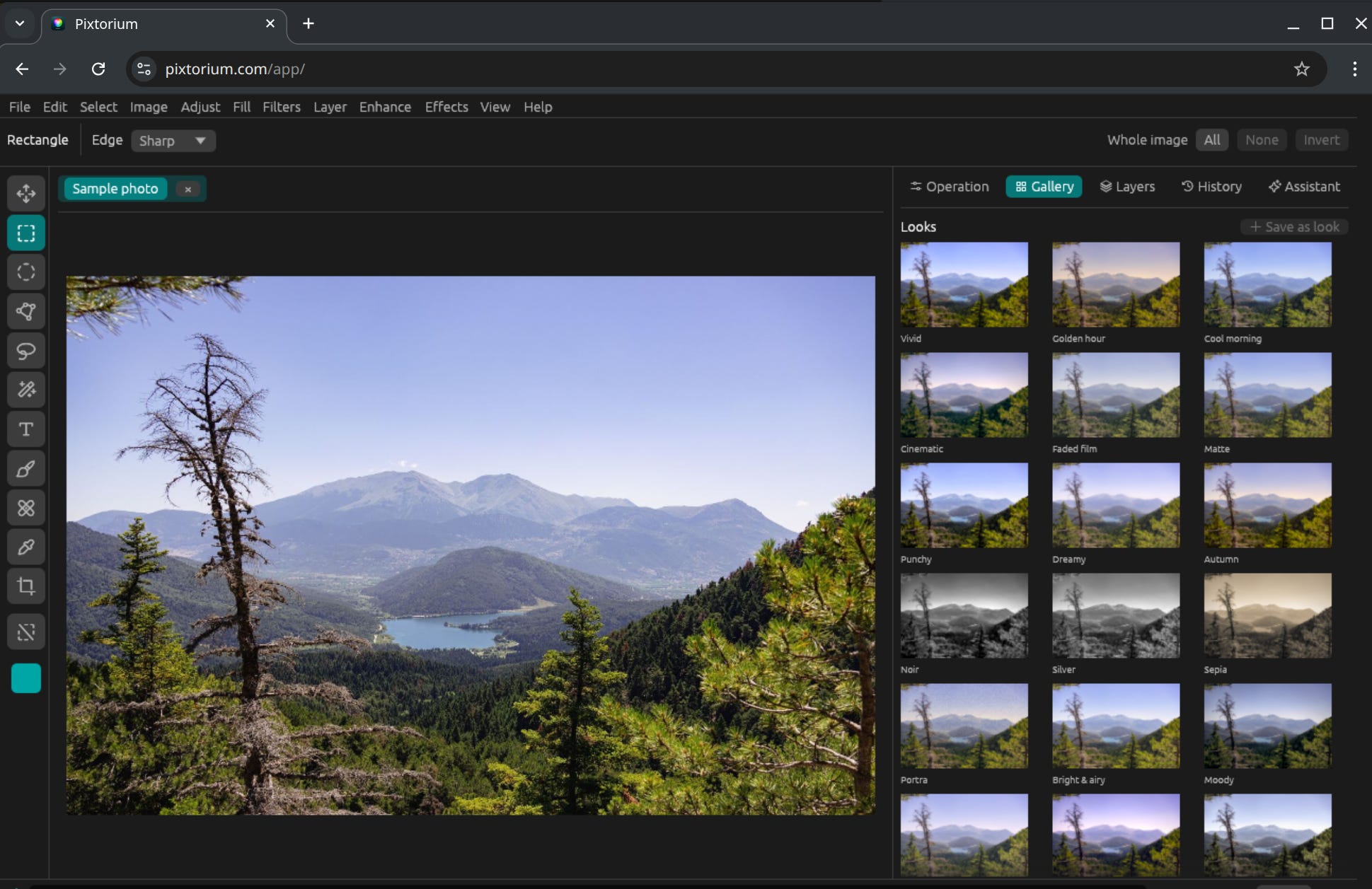
I had a lot of fun last week. First, I came across an image editor that I wrote in the USSR with friends 35 years ago. It was a Windows 3.0 program. I’d heard of people successfully disassembling old code with modern AI assistants, so I decided to give it a try. It took only two hours to have it rewritten in Rust and running on my Linux box as well as in the browser. Here is my previous post about the experience.
That didn’t feel like enough. So I spent two more days (and under a grand in tokens) beefing it up: an Agda spec, a GUI testing framework for AI-driven QA. Add MCP, layers, more algorithms, AI integration, and… voila. Behold a modern image editing program. It’s not really a service, since everything runs locally in your browser.
Until recently this was state of the art, and people had to put man-months and man-years into it. Now all it takes is a Claude Code or Codex subscription and some modicum of understanding of what you want. You get free software, but not in Richard Stallman’s sense.
It struck me that I’ve already seen this story unfold. Look at the evolution of the music industry. In the 70s, rock bands had to get signed to even have a chance at success. Making a record took an expensive studio, properly equipped with multitrack tape recorders, mixers, soundproof rooms, etc. Then came distribution, which was also expensive, and then marketing. So the gates to success came early, and on the other side we had a common culture. Everyone knew who Pink Floyd were.
Then in the 80s came MIDI, computers and audio interfaces. Suddenly an expensive studio wasn’t necessary. Your Macintosh became one. Then Napster upended distribution. Then came YouTube and SoundCloud. Now we’re witnessing another turn of the crank with Suno.ai, which I personally enjoy very much. Not only can it turn a prompt into a passable track, it can also faithfully arrange your original musical ideas. If you listen to Rick Beato, you’ll hear a lot more on this subject.
But what did we get? Did we get more musical geniuses? Did we get more music that became part of the shared culture, the way Pink Floyd did? Not really. I’m not sure the total amount of money in the music industry, broadly speaking, got bigger. What I am sure of is that the distribution of returns became more long-tailed. For an average good musician, it became progressively harder to make a living off music.
Another example of such a long-tailed distribution is OnlyFans. Last year it paid creators $6.3 billion, which works out to about $200 a month for the average active creator. That average includes more than 5,000 creators who have each made over a million. Everything is super democratic.
I’m afraid this is what’s happening to the software industry. The barrier to entry is falling before our eyes. The moat is no longer in the code.
So what will we have in the end? A bunch of bespoke software? A handful of software companies making most of the money?
Both, I suspect. A billion bespoke programs, and a handful of companies collecting a toll on every one of them. Who won in music? The platforms: Spotify, YouTube. Who wins in software? Check your token bill.
One difference gives me hope, though. A song nobody listens to is a hobby. A program nobody else uses still edits my pictures. Maybe most software just stops being a product. Home-cooked, as Robin Sloan put it.