
The short version
Myself and Claude Code got curious today about what is the statistics and trends in hiring software engineers are. Claude was kind enough to run research for me, I only had to instruct it, and manually log into some sites. We looked at job postings on seven boards, about 300 search terms each, to analyze where software money is actually going. The text below is the result of the analysis, and it is consequently heavily AI generated.
The main takeaways are.
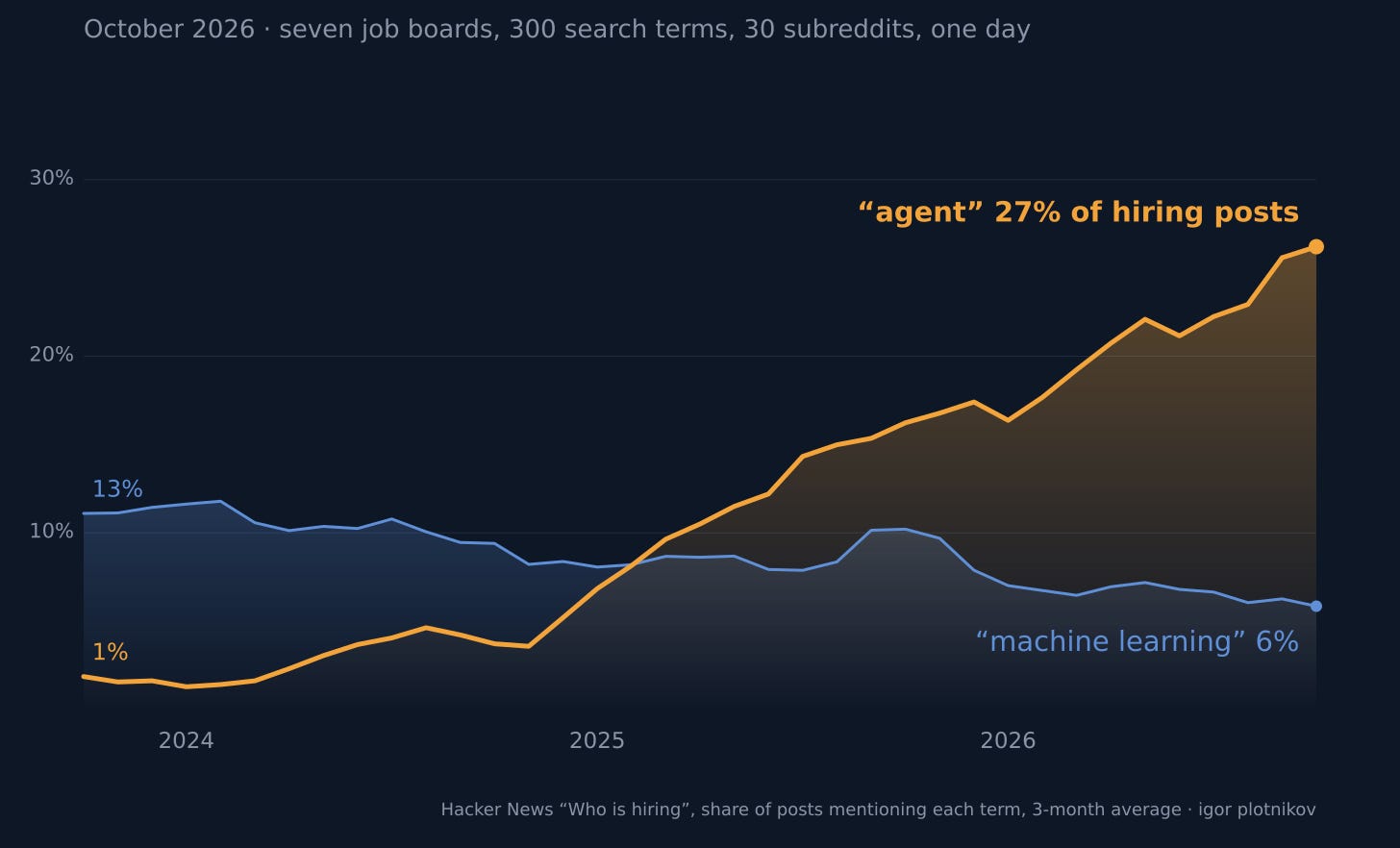
The agent wave is real and it is replacing machine learning as the thing companies say they want. On Hacker News hiring threads the word “agent” went from 1 percent of posts in October 2023 to 27 percent in October 2026, while “machine learning” fell by more than half.
As you probably already heard, “forward deployed engineer” is the hottest software title in the country: 1,771 LinkedIn postings in one week, more than “AI engineer” and “machine learning engineer” combined, at $184k to $257k printed.
The money behind it is in regulated finance and the consultancies that sell to it. Capital One, Citi, American Express, JPMorgan and Goldman Sachs are the repeat names; Deloitte alone posted 19 of the first 100 “AI transformation” roles.
Compliance is bought, not hired. FedRAMP, CMMC, SOC 2, ISO 27001 and HITRUST each draw fewer than 100 postings a week. The same regimes sell as $57 to $71 an hour gigs on Upwork, but only at the SOC 2 and HIPAA tier.
Small businesses now name the model they want. Upwork has 2,721 open jobs mentioning Claude and 3,088 mentioning ChatGPT, with about 700 new ones a day between them, at $30 to $60 an hour.
Rust, formal methods, legacy modernisation, crypto and biotech have no buyer on any board. Rust’s biggest LinkedIn hirer this week is a paint company, Rust Oleum. I guess, most people writing in Rust today have no manual skills in the language. That includes me as well.
How this was measured
Job postings are the only public ledger of what companies are about to spend money on. A posting is a budget line someone fought for. So on 26 October 2026 I ran the same list of search terms through seven boards and read the counts.
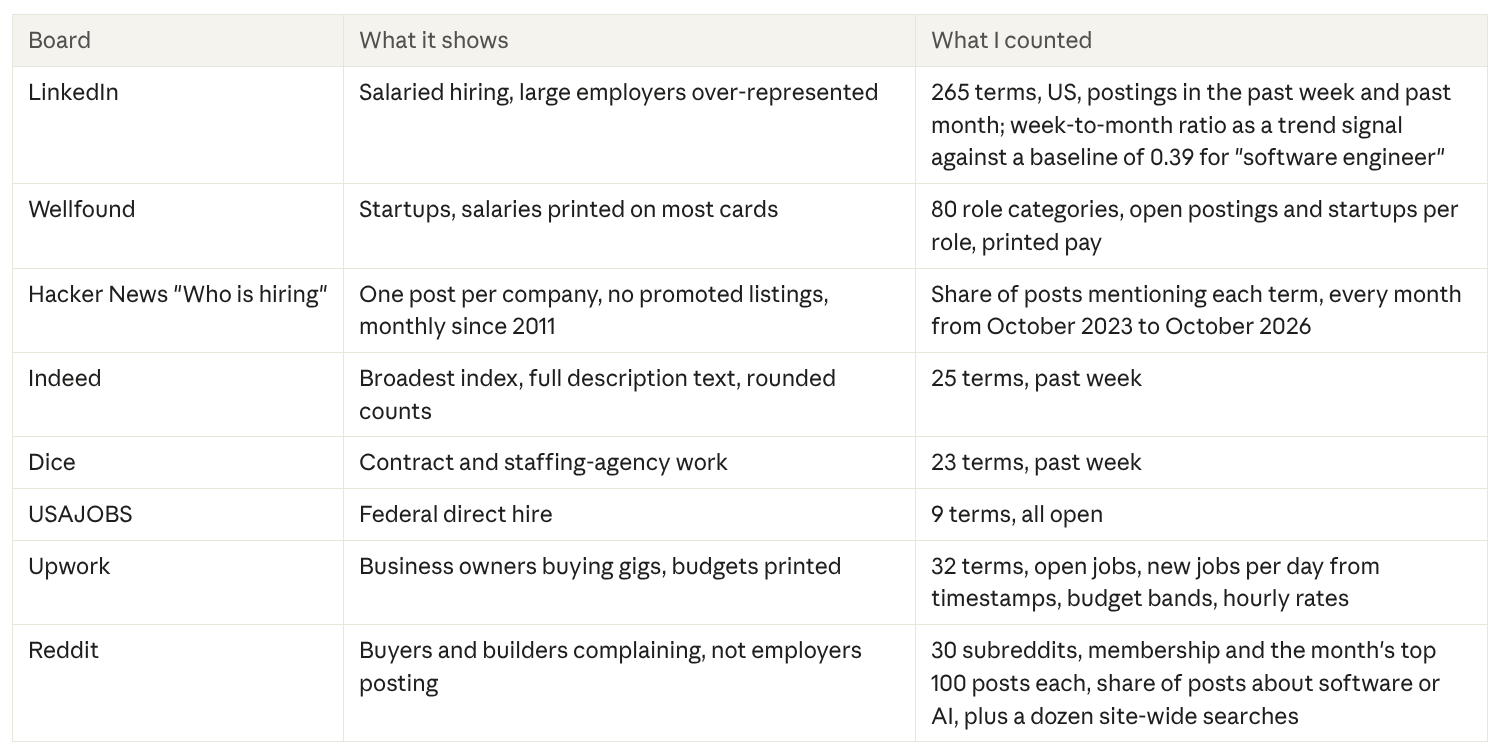
Two rules for reading the numbers. First, every board rounds or fuzzes differently, so compare terms within a board and directions across boards, never raw counts across boards. Second, a single word on LinkedIn (Perl, Fortran, Gong) returns a floor of about 4,000 to 6,500 a week regardless of real demand; only quoted phrases and multi-word terms are trusted there. Reddit is the one source here that is not a ledger of spending; it is where buyers complain rather than where employers post, so it gets its own section below and its numbers are shares of attention, not budgets.
The agent wave, in three years of Hacker News
The monthly Hacker News “Who is hiring” thread is the cleanest series there is: one post per company, no promoted listings, and the same format since 2011. I counted what share of each month’s posts mention four terms.
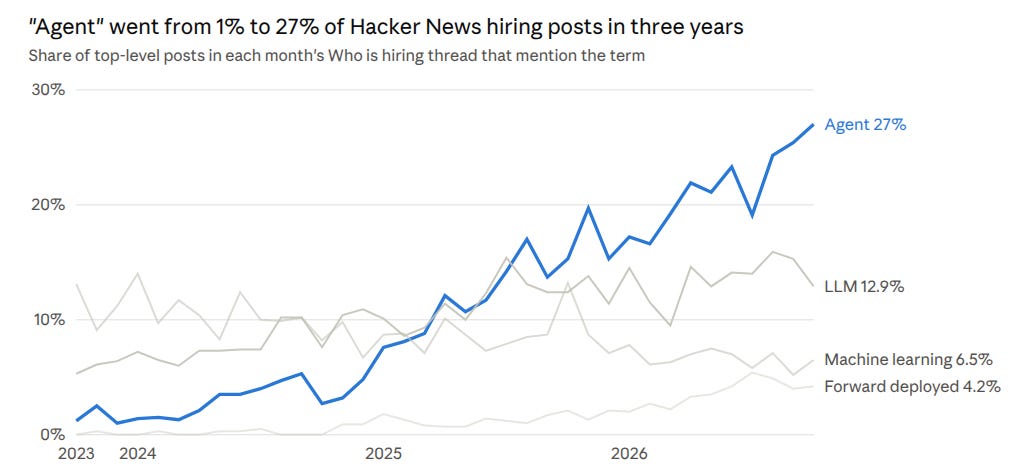
Three things in the picture. The word “agent” was noise until late 2024 and is now in more than a quarter of all posts. “Machine learning” has gone from 13 percent to 6 percent over the same period; nobody is hiring to train models, they are hiring to deploy them. And “forward deployed” did not exist as a phrase on HN before 2025 and is now in one post in 24. Thread volume itself is down a quarter year on year, 263 posts in October 2026 against 340 a year earlier, so the agent share is rising inside a shrinking pool: companies are posting less and asking for agents more. Crypto fell from 14 posts to 5 over the year, biotech has left the thread, and robotics doubled.
Forward deployed engineer is the hottest title
Palantir invented the title; in 2026 everyone uses it. (It really annoys me.) On LinkedIn “forward deployed engineer” drew 1,771 US postings in one week, against 1,389 for “AI engineer” and 672 for “machine learning engineer”. Its week-to-month ratio of 0.49 is well above the 0.39 baseline, so it is still accelerating. The same title is in 26 of 348 solutions engineer postings and 13 of 318 AI engineer postings on Wellfound, and it ties with “AI engineer” at about 300 a week on Indeed.

The pay is the tell. Of the first 100 LinkedIn postings, 25 printed a range, with medians of $184k at the low end and $257k at the high end and a top of $450k. Wellfound startups print $140k to $270k, with the seed-stage ones at $110k to $150k plus a quarter to half a percent of equity. The employers are not only the labs: Intuit, Analog Devices, Meta, Reddit, Docker, monday.com, BNY, American Express, Quanta Services, Nelnet, Deloitte and KPMG all posted the title this week.
What the title means in practice: an engineer who sits inside the customer’s organisation and makes an AI system work on the customer’s data, under the customer’s rules. Buyers have stopped asking for models and started asking for someone to make the model do the job. That is a services shape, and it is the shape the money is in.
Who is paying
Read the employer names on the AI postings and one industry dominates: regulated finance. Capital One posted six of the first 100 “agentic” roles on LinkedIn, American Express and Citi five each, and Ares Management, JPMorganChase, Goldman Sachs, USAA, State Street, Janus Henderson and LPL Financial recur under “applied AI”, “AI engineer” and “AI governance”. These are companies with model-risk departments and audit trails, and they are hiring to put agents inside them.
The second group is the consultancies that sell to the first. Deloitte posted 19 of the first 100 “AI transformation” roles this week; BDO posted seven of the first 100 “AI governance” roles; EY, PwC, KPMG, TCS, Infosys, Avanade and Luxoft fill the “AI architect” page. Consultancies staff ahead of the engagements they expect to sell, so this is a leading indicator of enterprise AI services spend in 2027.
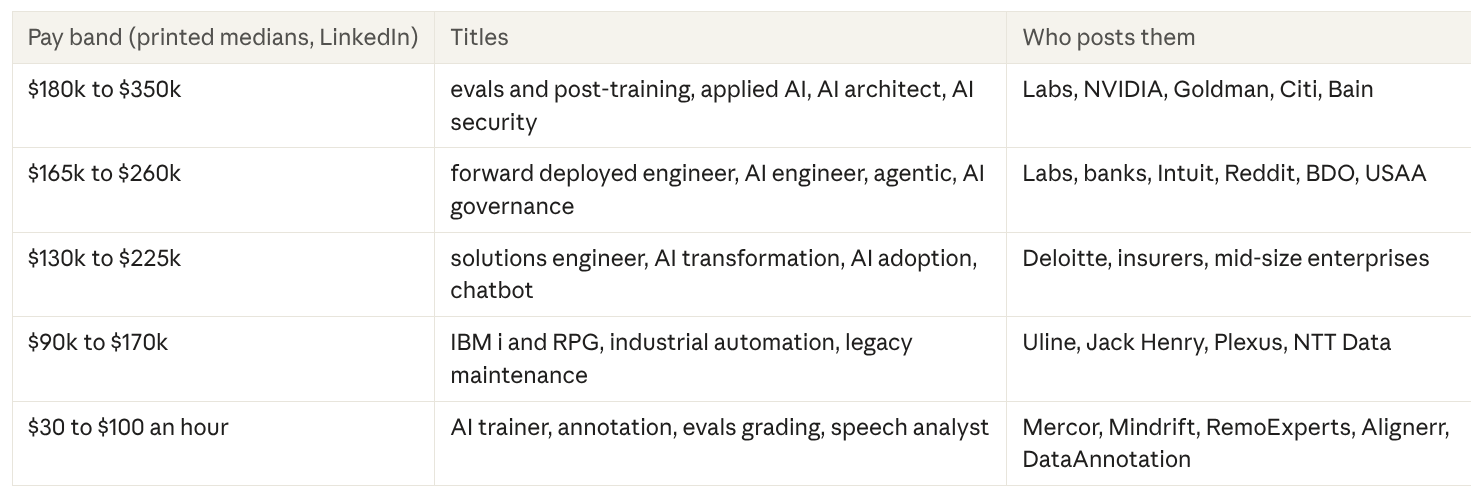
The last row is new. The labs are buying expert hours by the thousand through gig platforms: 341 LinkedIn postings a week for annotation and AI-trainer work, 39 of the first 100 “evals” postings from a single platform called Mindrift. A PhD can earn $50 to $150 an hour grading model outputs. It is income, not a business, but it is a visible labour market that did not exist two years ago.
Compliance is bought, not hired
If you want to know whether a regulation creates a software market or a staffing market, count the postings. HIPAA is in 36,599 LinkedIn postings a week because every healthcare job mentions it. The regimes software people talk about as moats barely appear.
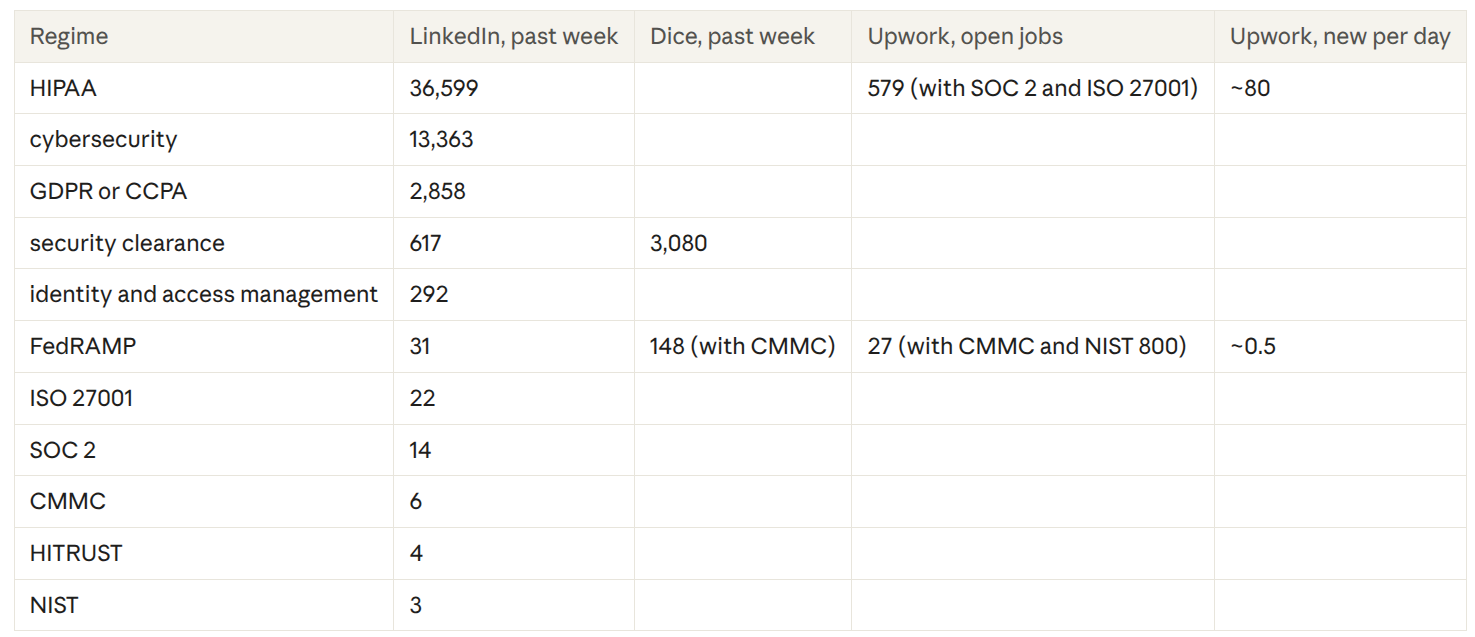
Nobody staffs for FedRAMP, CMMC, SOC 2 or ISO 27001. Companies buy them: from a consultancy, from a tool like Vanta or Drata, or from a $57 to $71 an hour Upwork freelancer, which is what the SOC 2 and HIPAA line on Upwork shows at about 80 new jobs a day with 37 percent of fixed budgets over $1,000. FedRAMP and CMMC do not even sell retail: one Upwork job every two days. The AI versions of the same story are already larger than the originals: “AI security” draws 342 LinkedIn postings a week, ten times FedRAMP, and “AI governance” 157, with BDO, USAA, State Street and LPL Financial as the hirers. That is a market standing up in-house programs this year, which is when the tooling gets bought.
The retail end: what small businesses buy on Upwork
Upwork is the one board where the buyer is the owner of the business, so it shows where small-business money goes rather than where headcount goes. I read the open-job counts and timed the ten newest posts for each term.
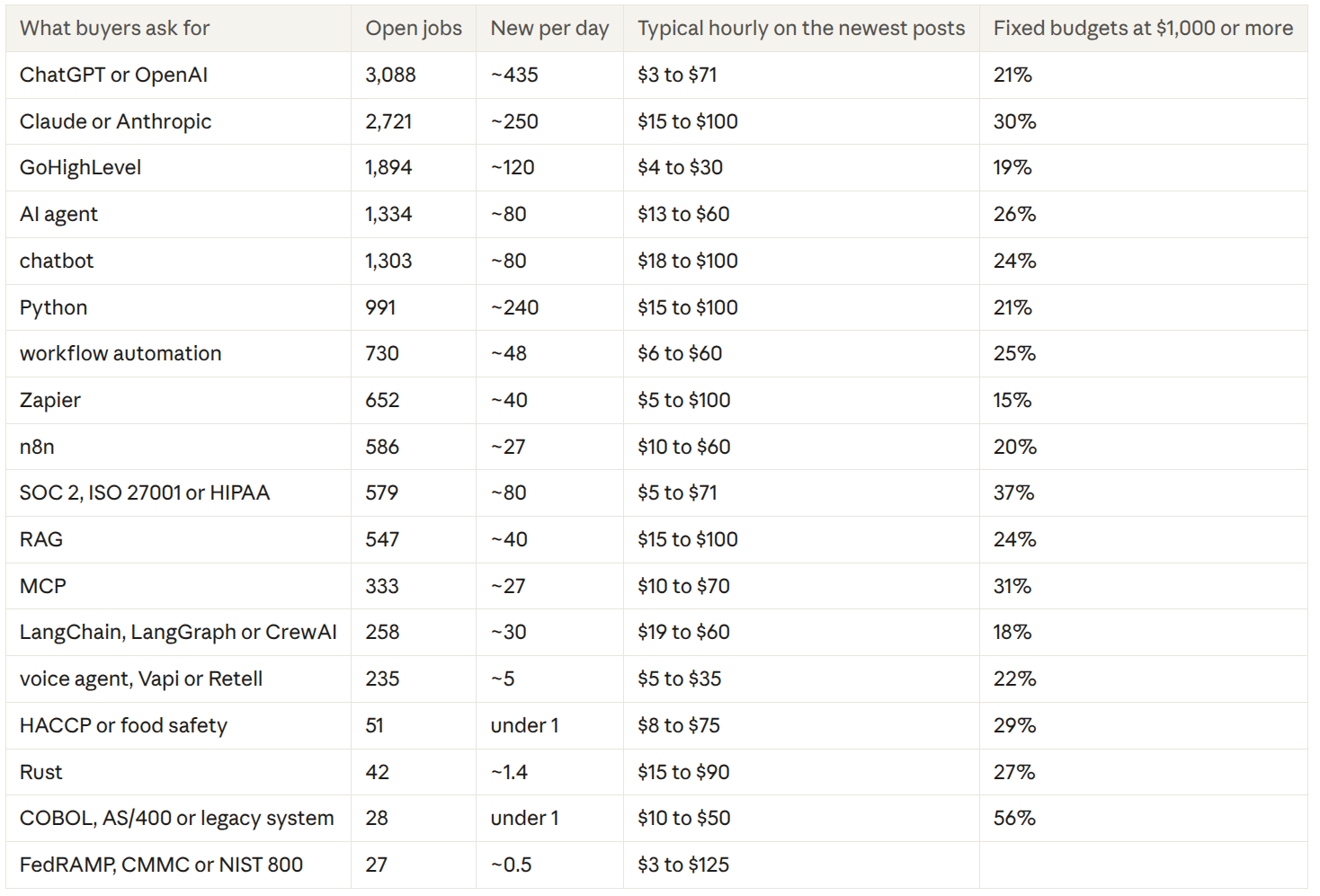
The striking line is the first two. Small businesses now specify the model by name, and they post about 700 such jobs a day. Agent, chatbot, RAG, MCP and LangChain together add roughly 250 a day at $30 to $60 an hour, with a quarter of fixed budgets at $1,000 or more. This is the same work as the forward-deployed engineer, bought one gig at a time at a hundredth of the price. For comparison, “lead generation” has 12,574 open jobs and about 690 new a day, and “data entry” 6,071 and 400 a day; those are the old floor of the gig economy, and the AI terms are now in the same order of magnitude.
What has no buyer
Some technologies that engineers love have no one on the other side of the counter.
Rust. 103 LinkedIn postings a week, and 26 of the first 99 are from Rust-Oleum, the paint company. 98 open jobs on Wellfound, 42 on Upwork, 178 contract postings on Dice. It is a steady 7 to 9 percent of HN posts, which says Rust shops are small and post on HN, not that there is a hiring wave.
Formal methods. 44 LinkedIn postings a week, and 16 of the first 45 are Alignerr training-data gigs, where the labs pay people to write proofs for models to learn from. One HN post in October 2026. Oh, that one was ours!
Legacy modernisation. Five LinkedIn postings a week under that phrase. COBOL and mainframe live on Dice as contract maintenance (254 a week) and nowhere else. 28 open jobs on Upwork.
Crypto. Down from 14 HN posts a month to 5 in a year. “Blockchain developer” has 58 open jobs on Wellfound.
Biotech. Seven HN posts in October 2023, one in October 2026.
Prompt engineering, fine-tuning, no-code tools as job skills. Prompt engineer 19 LinkedIn postings a week, fine-tuning 7, n8n or Zapier 3, vibe coding 0. On Upwork these are products people buy, not skills employers hire for.
None of these is dead as a technology. They are dead as a thing a buyer searches for. A business built on one of them has to be sold on something else and use the technology as the moat behind it.
Sectors warming and cooling
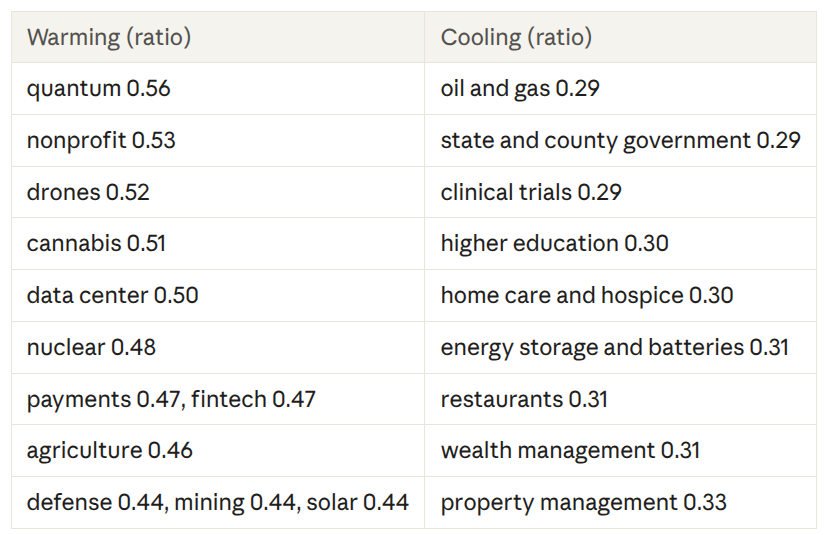
The LinkedIn week-to-month ratio is a cheap trend signal: 0.39 is the baseline, higher means postings are accelerating, lower means they are drying up. The giants (healthcare 149,286 postings a week, construction 117,539, manufacturing 116,256, retail 112,990, insurance 108,491) all sit at 0.37 to 0.39. No surge anywhere in the big economy. The movement is at the edges.
Warming (ratio)Cooling (ratio)quantum 0.56oil and gas 0.29nonprofit 0.53state and county government 0.29drones 0.52clinical trials 0.29cannabis 0.51higher education 0.30data center 0.50home care and hospice 0.30nuclear 0.48energy storage and batteries 0.31payments 0.47, fintech 0.47restaurants 0.31agriculture 0.46wealth management 0.31defense 0.44, mining 0.44, solar 0.44property management 0.33
Hacker News agrees on the direction: robotics doubled over the year and defense went from one post to seven, while climate and energy postings peaked in 2024 and have halved since. Among back-office roles, customer service, data analyst and business analyst are warming at 0.51 to 0.52, while loan officer and underwriter are cooling at 0.29 and 0.35. Energy, defense and AI infrastructure are the sectors with budgets opening; consumer credit, government and higher education are the ones closing them.
What buyers say on Reddit
Job boards show what employers want. Reddit shows what buyers complain about, so I pulled the month’s top 100 posts from 30 business and builder subreddits. The result is a silence worth noticing. In r/smallbusiness, 2.56 million members, two of the top 100 posts this month ask about software or AI; the rest are about chargebacks, staff and money getting harder. r/restaurantowners, r/HVAC, r/Construction, r/Dentistry and r/Landlord are the same. A post asking restaurant owners whether they have used AI for anything got zero upvotes and 61 comments.
Put the two sources together and the picture is consistent. Business owners do not discuss AI; they post a $500 gig on Upwork and move on. Builders discuss it constantly, and what they are discussing in late 2026 is whether the thing works and what it costs. That is the demand curve for evaluation and governance tooling, and it matches the postings: the r/grc community’s top question this month is whether AI governance lands inside the GRC team or becomes its own role.
What it means for a two-person software company
I did this scan because I am choosing what to build next with one partner and no outside money. Here is what the ledger says.
Services demand is specific and already budgeted. Banks and insurers are hiring forward-deployed engineers at $184k to $257k, and the consultancies are staffing to sell the same work. A two-person shop can bill day rates off those salaries, but the work is sold by relationship, through the consultancies or directly to a mid-size regulated buyer. It is income, and it is the most reliable income on the board.
Product demand is where nobody staffs. Compliance regimes are bought, and AI governance and evals are the two AI niches where a tool replaces a hire. The buyers standing up AI governance programs this year (BDO, USAA, State Street, LPL) will buy tooling next year.
Small-business AI spend is real but retail-priced. Seven hundred model-named gigs a day at $30 to $60 an hour, with budgets mostly under $1,000. A product that replaces a $500 gig is viable at $50 to $100 a month, and the buyers already know what they want because they have been writing the gig descriptions.
Vertical SMB software has no implementation economy. Salesforce has 27,601 postings a week; Procore 41, ServiceTitan 13, Jobber 0. Nobody is paid to implement SMB vertical tools, so they must sell themselves. That favours a product with a free trial and kills a consulting play in those niches.
The technology you love is not a market. Rust, formal methods and legacy retrofit have no buyer anywhere. They can be the moat inside a product; they cannot be the thing on the sign.
Energy, defense and AI infrastructure are where budgets are opening. If the product needs a tailwind, those are the sectors with one.
Sources and caveats
All counts were read on 26 October 2026. LinkedIn, Wellfound and Upwork were read from my own logged-in sessions; Hacker News through the public Algolia API; Indeed, Dice and USAJOBS without an account. The full tables, 265 LinkedIn terms with week and month counts, 80 Wellfound roles with pay, 37 months of Hacker News, and the Indeed, Dice, USAJOBS and Upwork pulls, are in the working document LinkedIn Jobs Pulse.
LinkedIn counts are the site’s own estimates and include fuzzy matches. Quoted phrases are tight; single words have a floor of roughly 4,000 to 6,500 a week that did not move when spell correction was turned off, so single-word counts are excluded from every ranking above.
The week-to-month ratio depends on LinkedIn’s index decaying as postings close; 0.39 for “software engineer” is the baseline, not 0.25.
Indeed rounds to one significant figure, treats a bare brand name as an employer filter, and began returning challenge pages after about twenty loads, so its pass is short.
Upwork’s new-jobs-per-day figures come from the timestamps of the ten newest posts and are rough; a term with ten posts over a week reads as about 1.4 a day.
Printed pay is the floor of what employers choose to publish, not a market median. Most postings print nothing.
Employer names are from the first one to three pages of relevance-sorted results and lean toward large and promoted employers.
Reddit was read through Chrome DevTools from a logged-in session: subreddit membership, the month’s top 100 posts for 30 subreddits, and a dozen site-wide searches, which return only the first page of results.